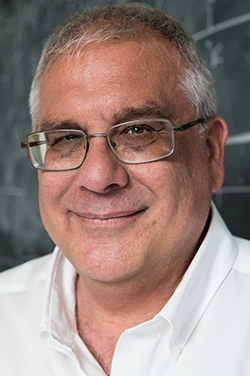
Dr. Peter Guy Wolynes is a world-renowned theoretical chemist and physicist who currently serves as the D.R. Bullard-Welch Foundation Professor of Science at Rice University with appointments spanning Chemistry, Physics and Astronomy, BioSciences, and Materials Science and Engineering. After earning his A.B. in Chemistry from Indiana University in 1971 and a Ph.D. in Chemical Physics from Harvard University in 1976, he established his scholarly reputation through postdoctoral work at MIT with John Deutch followed by an assistant professorship at Harvard. His distinguished career includes significant tenures at the University of Illinois at Urbana-Champaign where he became the Center for Advanced Study Professor of Chemistry, Physics and Biophysics, and at the University of California, San Diego where he held the Francis H.C. Crick Chair of Physical Sciences before joining Rice University in 2011. His interdisciplinary approach has consistently bridged the theoretical foundations of chemistry, physics, and biology throughout his illustrious academic journey.
Dr. Wolynes is globally recognized for his groundbreaking development of the Energy Landscapes Theory and Principle of Minimal Frustration, which revolutionized the understanding of protein folding by demonstrating that naturally evolved proteins possess optimized folding energy landscapes with minimized energetic frustration. His seminal 1987 work with Joseph Bryngelson established that nature selects amino acid sequences to ensure the folded state achieves sufficient stability, creating the conceptual framework of the 'folding funnel' that now guides both experimental studies and computational structure prediction algorithms. This theoretical foundation has profoundly influenced structural biology, enabling more accurate protein structure prediction methods that have accelerated drug discovery and our understanding of folding-related diseases. His contributions extend beyond protein science to the Random First Order Transition theory of glass formation and applications of energy landscape principles to gene regulatory networks and cellular processes.
As a member of the National Academy of Sciences, the American Academy of Arts and Sciences, the German Academy of Sciences Leopoldina, and a Foreign Member of the Royal Society, Dr. Wolynes has shaped the theoretical foundations of multiple scientific disciplines through his rigorous mathematical approaches to complex biological phenomena. His research continues to evolve as he applies energy landscape theory to increasingly complex biological systems including chromosome dynamics and the molecular mechanisms of long-term memory, while co-directing the NSF Center for Theoretical Biological Physics at Rice University. His extensive mentorship has cultivated generations of theoretical scientists who now lead research programs worldwide, and his conceptual frameworks remain fundamental to understanding biomolecular organization and function. Dr. Wolynes' ongoing work promises to further illuminate the physical principles governing living systems through the elegant application of statistical mechanics to biological complexity.