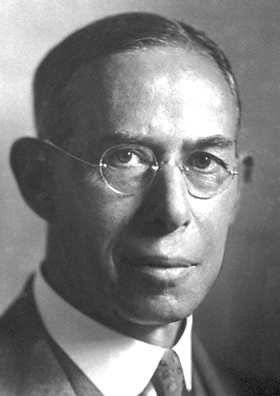
Joseph Erlanger was a pioneering American physiologist born on January 5, 1874, in San Francisco, California, to German immigrant parents. He earned his Bachelor of Science degree from the University of California before pursuing medical studies at Johns Hopkins University, where he received his medical degree in 1899. Erlanger began his academic career at Johns Hopkins School of Medicine, serving as an instructor and associate professor from 1900 to 1906, where his research on canine digestive systems attracted the attention of prominent physiology professor William Henry Howell. In 1906, he became the first Professor of Physiology at the University of Wisconsin Medical School, and by 1910 had established himself at Washington University in St. Louis, where he would spend the majority of his career and make his most significant scientific contributions.
Erlanger's most groundbreaking work emerged from his collaboration with Herbert Spencer Gasser, beginning at the University of Wisconsin and continuing at Washington University. Together, they revolutionized neurophysiology by developing specialized equipment to amplify and analyze nerve impulses, successfully recording the action potential of a single nerve fiber using a cathode-ray oscilloscope in 1922. Their systematic research demonstrated that nerve fibers exist in multiple types with distinct conduction properties, establishing the fundamental relationship between nerve fiber diameter and the velocity of action potential transmission. This work culminated in their 1932 classification system that revealed how different nerve fibers conduct impulses at varying rates and have different thresholds for excitability, a discovery that fundamentally transformed understanding of neural communication and earned them the Nobel Prize in Physiology or Medicine in 1944.
Beyond his Nobel-winning research, Erlanger significantly influenced physiology through his leadership as president of the American Physiological Society from 1926 to 1927 and his mentorship of future generations of scientists, including his collaborator Gasser. His earlier work on cardiovascular physiology, including studies of the Bundle of His and development of an improved sphygmomanometer, established his reputation before his turn to neurophysiology. The classification system he developed with Gasser remains foundational to modern neuroscience, providing the framework for understanding sensory processing, pain mechanisms, and neurological disorders. In a notable gesture honoring his scientific legacy, his family gifted Erlanger's Nobel medal to the American Physiological Society, ensuring that his contributions to physiological science continue to inspire future researchers.