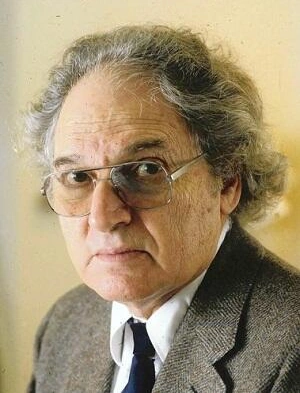
Herbert A. Hauptman was a pioneering American mathematician and crystallographer whose revolutionary work transformed the field of molecular structure determination. Born on February 14, 1917, in New York City to Israel Hauptman, a printer, and Leah Hauptman, he demonstrated exceptional aptitude in mathematics from an early age. He graduated from Townsend Harris High School in 1933 and earned his bachelor's degree from the City College of New York in 1937, followed by a master's degree in mathematics from Columbia University in 1939. After completing his Ph.D. in mathematics at the University of Maryland in 1955, he established himself as a leading figure at the intersection of mathematics and chemistry through his groundbreaking research.
Hauptman's most significant contribution was the development of direct methods for solving the phase problem in X-ray crystallography, a collaboration with Jerome Karle that began at the Naval Research Laboratory in Washington, D.C. Their seminal 1953 monograph "Solution of the Phase Problem I. The Centrosymmetric Crystal" introduced probabilistic mathematical approaches that enabled scientists to determine molecular structures from X-ray diffraction patterns using only intensity measurements. This mathematical framework, initially met with skepticism, revolutionized structural chemistry by reducing complex structure determinations from years to days when implemented with emerging computer technology. For this transformative work that underpins modern crystallographic analysis, Hauptman and Karle were jointly awarded the Nobel Prize in Chemistry in 1985.
Throughout his career, Hauptman continued to refine and extend his methodologies, formulating the neighborhood principle and extension concept during his tenure at the Medical Foundation of Buffalo, where he served as Research Director beginning in 1972. His enduring impact was recognized when the institution was renamed the Hauptman-Woodward Medical Research Institute in 1994. Hauptman received numerous honors including the Patterson Award from the American Crystallographic Association and multiple international honorary doctorates. His mathematical approaches remain foundational to contemporary research, enabling the determination of increasingly complex molecular structures that drive innovation in pharmaceutical development, materials science, and biochemical research worldwide.