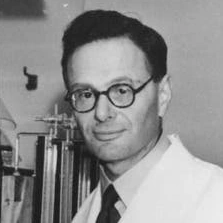
Sir Hans Adolf Krebs was a pioneering German-British biochemist born in Hildesheim, Germany on August 25, 1900, who made foundational contributions to our understanding of cellular metabolism. After earning his medical degree from the University of Hamburg in 1925, he initially pursued clinical work before transitioning to biochemical research under the guidance of Otto Warburg. His promising career in Germany was abruptly halted in 1933 when the Nazi regime dismissed him from his position at the University of Freiburg due to his Jewish heritage, forcing him to emigrate to England. Krebs established himself at the University of Cambridge as a Demonstrator in Biochemistry from 1933 to 1935, before moving to the University of Sheffield where he became a lecturer and later a professor, positions that provided him with the stability to conduct his most significant research.
Krebs' most groundbreaking contribution was the discovery of the citric acid cycle in 1937, a series of chemical reactions central to cellular respiration that converts nutrients into energy in the form of ATP, a discovery that revolutionized biochemistry and earned him the Nobel Prize in Physiology or Medicine in 1953. Prior to this, in 1932, he had already made a significant breakthrough by identifying the urea cycle with his research student Kurt Henseleit, which explained how mammals convert toxic ammonia into urea for excretion. His work fundamentally altered the understanding of metabolism by introducing the concept of cyclic metabolic pathways, moving biochemistry from a linear to a cyclical understanding of cellular processes. The citric acid cycle, now universally known as the Krebs cycle, became one of the most fundamental concepts in biochemistry, explaining how living organisms extract energy from carbohydrates, fats, and proteins through aerobic respiration.
Beyond his specific discoveries, Krebs' conceptual framework of metabolic cycles transformed biochemistry into a more integrated science, demonstrating that metabolic processes function as interconnected networks rather than isolated reactions. His work laid the foundation for modern understanding of cellular energy production and has profound implications for medicine, particularly in understanding metabolic disorders and developing treatments. Krebs was knighted by Queen Elizabeth II in 1958 for his contributions to science, cementing his status as one of Britain's most distinguished scientists. He continued his research at the University of Oxford until his death on November 22, 1981, leaving a legacy that continues to influence biochemistry, medicine, and biological sciences worldwide, with his discoveries remaining fundamental components of scientific education and research.