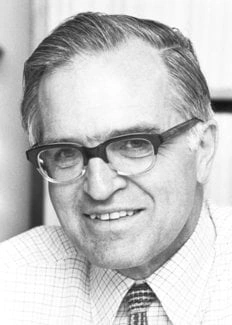
Dr. Aage Niels Bohr was a distinguished Danish nuclear physicist born on June 19, 1922, in Copenhagen as the fourth son of the renowned physicist Niels Bohr and Margrethe Bohr. He completed his physics studies at the University of Copenhagen and began his research career during World War II, working alongside his father at the Los Alamos Scientific Laboratory. Following postdoctoral work at the Institute for Advanced Study in Princeton and Columbia University in the late 1940s, he returned to Copenhagen where he would spend most of his career. In 1956, he became Professor of Physics at the University of Copenhagen and succeeded his father as Director of the Niels Bohr Institute in 1962, a position he held until 1970.
Dr. Bohr's groundbreaking research revolutionized our understanding of atomic nucleus structure through his discovery of the connection between collective motion and particle motion within nuclei. Working collaboratively with Ben Mottelson and building upon James Rainwater's initial ideas, he developed the unified model of nuclear structure that demonstrated nuclei are not perfectly spherical but can be distorted by the motion of subatomic particles. Their seminal work, published in a 173-page report in 1953 and Bohr's subsequent book Rotational States of Atomic Nuclei in 1954, provided comprehensive theoretical frameworks that accurately predicted nuclear behavior observed in experiments. This paradigm-shifting research fundamentally advanced nuclear physics and had profound implications for understanding nuclear fusion processes, ultimately earning them the 1975 Nobel Prize in Physics.
Beyond his Nobel-winning contributions, Dr. Bohr played a pivotal role in establishing the Niels Bohr Institute as an international hub for theoretical physics, continuing his father's legacy of fostering global scientific collaboration. His collaborative work with Mottelson extended over decades, culminating in the two-volume treatise Nuclear Structure published in 1969 and 1975, which became definitive references in the field. Dr. Bohr's theoretical frameworks revealed that nuclei exhibit complex behaviors including rotation and vibration, with surface waves traveling around the nucleus rather than rotating as rigid objects. His enduring influence continues to shape nuclear physics research worldwide, as scientists still build upon his foundational insights into the intricate dynamics of atomic nuclei despite ongoing challenges in fully resolving nuclear structural details.